You’ve run the numbers. You now know what your wedding is likely to emit — perhaps 14.5 tonnes CO2e if you’re close to the UK average, or maybe considerably more or less depending on your choices. The donut chart highlights your top three contributors, but knowing what they are is only half the battle. The other half is figuring out what to actually do about them.
This is the first in a short series breaking down practical steps for each of the three categories that consistently dominate UK wedding footprints: travel, food and drink, and decor. Each post will focus on one area, so you can work through them at your own pace as your planning progresses.
Why these three?
Research and industry life cycle assessments consistently show that guest travel, catering, and decorative elements account for the largest share of emissions in a typical UK wedding. Travel alone can represent up to 70% of total emissions when international guests are involved, while food and drink tends to be the second-largest contributor, particularly for larger guest lists or meat-heavy menus. Decor sounds minor until you factor in imported out-of-season flowers, single-use plastics, and hired items shipped from afar.
The good news: SWA’s data suggests that at least half of an average wedding’s footprint can be reduced through considered choices, without compromising the magic of the day. That’s roughly 7 tonnes CO2e saved per wedding — meaningful on its own, and enormous when multiplied across the 230,000 (ish) weddings held in the UK each year.
A note on offsets
If you see “offset” mentioned in passing elsewhere, treat it as a last resort, not a strategy. The most effective approach is reduction first. Offsetting remaining emissions can play a small role, but it should never substitute for cutting the biggest sources upfront.
Cutting Your Travel Footprint
Travel is where most couples find their biggest number, and fortunately also where the most dramatic reductions are possible. Here’s what makes a difference:
Venue location is your lever. Choosing a venue that minimises the average distance your guests need to travel has more impact than almost any other single decision. If you have family spread across the country or abroad, consider whether a central location or a weekend format (allowing guests to stay over rather than commute) might reduce overall journeys. For destination weddings, be honest about the multiplier effect: every guest flying in adds significantly to the total, and there’s no way around that arithmetic.
Encourage shared and rail travel. Trains produce around 56g CO2e per passenger mile compared to much higher figures for cars and flights. Providing clear information about rail routes, group booking discounts, or even organising a few minibus hires for local clusters of guests can shift a meaningful chunk of emissions away from solo car journeys. Some couples include a “travel tip” card with invitations or on their wedding website specifically suggesting rail options and connecting services.
Be transparent with international guests. If guests are flying, acknowledge it openly in your communications. Some couples suggest pooling accommodation near airports to reduce onward car transfers, or timing the invitation well enough that guests can book earlier fares (which sometimes allow slightly more efficient routing). There’s no perfect solution for air travel, but reducing the number of flyers — by being realistic about who truly needs to attend from overseas — is the single most effective step.
Consider a smaller guest list strategically. This is rarely popular advice, but it bears repeating: the size of your guest list directly multiplies every other category, including travel. If you’re torn between 120 and 180 guests, the carbon difference is substantial across all categories, not just travel.
Food, Drink, and Decor Choices That Matter
Food and drink often surprises couples because it edges past travel for many UK weddings, especially those with moderate domestic travel. The methodology behind the calculator draws on industry-specific life cycle assessment data, which shows that ingredient choice matters enormously. Beef, for instance, carries roughly 99 kg CO2e per kilogram, compared to about 8.34 kg for chicken and far less still for vegetables, grains, and pulses. That gap compounds quickly across a full menu.
Menu design is your biggest tool. You don’t need a fully vegan wedding to make a significant dent. Shifting from beef-centric mains to poultry, fish, or plant-based options can cut catering emissions dramatically. Many caterers now offer mixed menus where the lower-carbon option is presented attractively rather than as an afterthought, and couples report that guests gravitate toward well-prepared vegetable dishes anyway. Seasonality matters too: serving ingredients that are in peak British season reduces both transport emissions and the energy costs of growing out-of-season produce indoors.
Talk to your caterer early. Ask specifically about sourcing radius, seasonal availability, and how they handle food waste. Reputable sustainably minded caterers will have answers ready and may even adjust portions based on headcount accuracy to minimise leftovers. Smaller tasting plates rather than heavy three-course meals can also reduce both waste and total emissions per guest.
Drinks add up more than you’d think. Imported wines and spirits carry shipping emissions, and champagne specifically has a notable footprint due to production methods and transport. Consider a mix that includes local or regional options alongside favourites, or ask your venue about their standard offerings before adding premium imports.
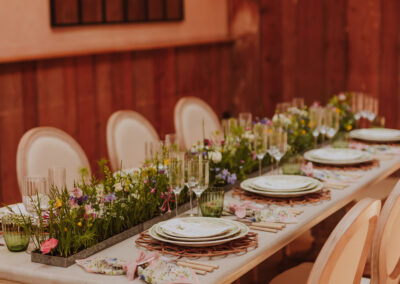
Decor: focus on flowers and disposables. Flowers are the sneaky one here. Out-of-season blooms flown in from Kenya, Ecuador, or the Netherlands carry significant aviation and refrigeration emissions, plus pesticide impacts at source. British-grown, seasonal flowers are beautiful precisely because they’re at their peak, and florists who specialise in them can create stunning arrangements without the jet lag. If your vision absolutely requires certain out-of-season stems, ask your florist about the trade-off and whether a hybrid approach (local bulk with a few imported accent stems) could honour the look while cutting the footprint.
Beyond flowers, audit the disposable elements: confetti, tableware, signage, favours. Plant and petal confetti is better than plastic, but skipping confetti altogether eliminates the issue entirely. Reusable or genuinely compostable tableware beats “biodegradable” plastics that require industrial composting facilities most venues don’t have access to. Favours that are edible or planted (rather than trinkets, sunglasses and foam wands left in hotel rooms) turn a potential waste stream into something guests actually use.
Lighting and energy at the venue round out the picture. Maximising natural light during daytime ceremonies, using LED rather than halogen for evening ambience, and asking your venue about their energy mix are small asks that add up, particularly for longer events extending into the evening.
Bringing it all together
You don’t need to do everything. Pick the two or three changes that feel most aligned with your values and practical reality, implement those well, and let the rest go. The calculator exists to show you where your specific footprint lies, not to set a guilt threshold. A wedding that cuts its footprint by 40% through thoughtful choices is a genuine success, whatever the absolute number turns out to be.
When you’re ready to check your progress, you can rerun the calculator with your updated plans and see the shift. And if you found these tips useful, the Conscious Couples planning blog has deeper dives on individual topics — seasonal flowers, pre-loved attire, venue selection, and more — whenever you want to explore further.
Congratulations again on your upcoming celebration. Planning it consciously doesn’t mean planning it anxiously; it means starting your marriage with the same care you’re giving to the world you’ll share.
Sources
Average UK wedding footprint, reducibility, and scale of impact. Why does the wedding industry need to be more sustainable?
Challenges and practical alternatives (flowers, venues, waste). What are the challenges when planning a sustainable weddingLuxury London – The green wedding guide: How to throw a sustainable wedding
Travel as the largest contributor. How to Plan a Sustainable Wedding: Tips from a Nottingham Wedding Venue
Office for National Statistics. Marriages and civil partnerships in England and Wales: 2023